 18 June, 2026
How AI Is Changing Customer Expectations for USA Businesses
Artificial Intelligence (AI) is no longer a futuristic concept. It has become part of everyday life, influencing how people search for information, shop online, communicate with businesses, and make purchasing decisions. From AI-powered chatbots and recommendation engines to virtual assistants and voice agents, technology is transforming customer experiences across every industry.
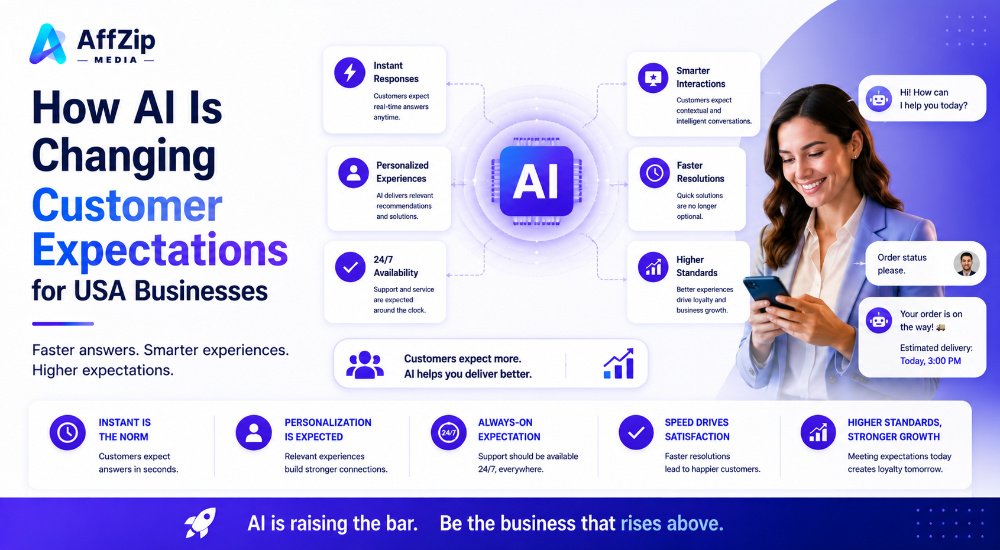
As AI becomes more accessible, customer expectations are evolving rapidly. Consumers now expect faster responses, personalized interactions, seamless experiences, and 24/7 availability. Businesses that fail to meet these expectations risk losing customers to competitors that embrace AI-driven engagement strategies.
For USA businesses, understanding how AI is reshaping customer expectations is essential for maintaining competitiveness and supporting long-term growth. Organizations that combine AI with marketing automation, CRM systems, and customer acquisition strategies are better positioned to attract, engage, and retain customers.
AffZip Media helps businesses implement Marketing Automation, CRM Integration, Lead Management, and AI-powered customer engagement solutions that align with modern customer expectations.
How AI Is Reshaping Customer Expectations
AI has changed the way people interact with technology. Consumers have become accustomed to receiving instant answers, personalized recommendations, and convenient digital experiences.
Platforms such as search engines, streaming services, online retailers, and customer support systems use AI to deliver relevant information and improve user experiences.
As a result, customers now expect businesses to provide the same level of convenience and responsiveness regardless of industry.
This shift has created a new standard where speed, personalization, and accessibility are no longer optional—they are expected.
Why Customers Expect Instant Responses
One of the most significant changes driven by AI is the expectation of immediate communication.
Consumers are increasingly impatient with delayed responses. When someone submits a form, requests a quote, schedules a consultation, or sends a message, they expect acknowledgment almost immediately.
This expectation has been influenced by:
- AI-powered chatbots
- Virtual assistants
- Instant messaging platforms
- Automated customer support systems
- Real-time notifications
Businesses that take hours or days to respond often struggle to compete against organizations that provide near-instant engagement.
The Shift Toward Personalized Customer Experiences
Modern customers expect businesses to understand their needs and preferences.
AI has enabled highly personalized experiences by analyzing customer behavior, interests, purchase history, and engagement patterns.
Examples include:
- Personalized product recommendations
- Customized email campaigns
- Targeted advertising
- Behavior-based content delivery
- Personalized customer support
Customers increasingly prefer businesses that provide relevant information rather than generic marketing messages.
How AI Is Changing Customer Communication
Traditional communication methods often rely on manual processes and limited availability. AI enables businesses to engage customers more efficiently and consistently.
AI-powered communication tools can:
- Answer common questions
- Provide instant support
- Route inquiries to appropriate teams
- Schedule appointments
- Deliver personalized recommendations
These capabilities improve customer experiences while reducing response times and operational costs.
The Rise of AI Voice Agents
AI voice agents are becoming an increasingly important part of customer engagement strategies.
Unlike traditional automated phone systems, AI voice agents can hold natural conversations, answer questions, qualify leads, and schedule appointments.
Businesses are using AI voice agents to:
- Handle incoming inquiries
- Respond to leads instantly
- Schedule consultations
- Provide customer support
- Reduce call wait times
As consumers become more familiar with AI-powered interactions, expectations for immediate and efficient communication continue to rise.
Why Slow Responses Are No Longer Acceptable
In the past, customers were willing to wait hours or even days for responses. Today, that expectation has changed dramatically.
AI-powered systems have conditioned consumers to expect rapid communication and immediate access to information.
Businesses that respond slowly may experience:
- Lost leads
- Lower conversion rates
- Reduced customer satisfaction
- Higher acquisition costs
- Competitive disadvantages
Organizations that prioritize speed often gain a significant advantage in customer acquisition and retention.
How AI Improves Customer Acquisition
Customer acquisition is becoming increasingly data-driven. AI helps businesses identify patterns, optimize campaigns, and engage prospects more effectively.
AI-powered customer acquisition strategies can:
- Improve audience targeting
- Increase lead quality
- Personalize marketing messages
- Optimize advertising campaigns
- Predict customer behavior
- Enhance lead nurturing efforts
These capabilities allow businesses to acquire customers more efficiently while improving overall marketing performance.
The Role of Marketing Automation in Meeting Customer Expectations
Marketing automation plays a critical role in helping businesses deliver the experiences that modern customers expect.
Automation enables organizations to:
- Respond to inquiries instantly
- Send personalized email sequences
- Automate follow-ups
- Segment audiences effectively
- Nurture leads consistently
- Track customer engagement
By automating repetitive tasks, businesses can focus more on building meaningful customer relationships.
How CRM Systems Support AI-Driven Experiences
Customer Relationship Management (CRM) systems provide the foundation for personalized and AI-powered interactions.
CRM platforms store valuable customer information including:
- Contact details
- Communication history
- Purchase activity
- Lead source information
- Customer preferences
When integrated with AI and marketing automation tools, CRM systems enable businesses to deliver highly relevant and personalized experiences at scale.
What USA Businesses Can Learn from AI-First Companies
Many successful organizations have embraced AI as a core part of their customer experience strategy.
These companies focus on:
- Fast response times
- Personalized communication
- Data-driven decision making
- Automation-driven efficiency
- Consistent customer engagement
Businesses that adopt similar principles can improve customer satisfaction while increasing operational efficiency.
Common Mistakes Businesses Make When Adopting AI
While AI offers significant benefits, implementation mistakes can limit results.
Common mistakes include:
- Implementing AI without a clear strategy
- Ignoring customer experience goals
- Failing to integrate CRM systems
- Over-automating communication
- Neglecting human oversight
Successful AI adoption requires balancing automation with personalized human interaction.
Preparing Your Business for AI-Powered Customer Expectations
Meeting modern customer expectations requires more than simply adopting new technology.
Businesses should focus on:
- Improving response times
- Implementing CRM systems
- Automating lead management
- Personalizing communication
- Using AI-powered customer engagement tools
- Optimizing customer journeys
These initiatives create a foundation for delivering exceptional customer experiences.
Why Businesses Are Investing in AI and Automation
AI and automation help businesses improve efficiency while meeting rising customer expectations.
Organizations are investing in these technologies because they support:
- Customer acquisition
- Lead management
- Marketing performance
- Customer retention
- Sales productivity
- Business scalability
As competition increases, AI-driven strategies are becoming essential rather than optional.
How AffZip Media Helps Businesses Adapt to AI-Driven Customer Expectations
AffZip Media helps USA businesses implement Marketing Automation, CRM Integration, Lead Nurturing, Customer Acquisition Systems, AI-powered workflows, and conversion optimization strategies designed to improve customer experiences.
Our solutions help businesses respond faster, personalize engagement, and create scalable growth systems that align with evolving customer expectations.
Frequently Asked Questions
How is AI changing customer expectations?
AI is increasing expectations for faster responses, personalized experiences, instant support, and seamless customer interactions.
Why do customers expect immediate responses today?
AI-powered tools, chatbots, messaging apps, and digital platforms have conditioned consumers to expect real-time communication.
Can AI improve customer acquisition?
Yes. AI helps businesses improve targeting, personalize marketing, optimize campaigns, and engage prospects more effectively.
How does marketing automation support customer expectations?
Marketing automation enables instant responses, personalized communication, lead nurturing, and consistent customer engagement.
Are AI voice agents replacing human customer service teams?
AI voice agents are designed to handle routine interactions and support teams, allowing human representatives to focus on more complex customer needs.
Conclusion
AI is fundamentally changing what customers expect from businesses. Faster responses, personalized communication, seamless experiences, and 24/7 accessibility are becoming the new standard across industries.
Businesses that embrace AI, Marketing Automation, CRM Integration, and customer engagement technologies will be better positioned to attract, convert, and retain customers in the years ahead.
Ready to modernize your customer experience and stay ahead of changing expectations? Contact AffZip Media to learn how our Marketing Automation, CRM, and Customer Acquisition solutions can help grow your business.