 10 June, 2026
Why First-Party Data Is Becoming More Valuable Than Ever for USA Businesses
As digital marketing continues to evolve, businesses across the United States are facing a major shift in how customer data is collected and used. For years, marketers relied heavily on third-party cookies and external data sources to target audiences, personalize campaigns, and optimize advertising performance. However, increasing privacy regulations, changing consumer expectations, and updates from major technology companies are reshaping the data landscape.
Today, first-party data has become one of the most valuable assets a business can own. Companies that successfully collect, manage, and utilize their own customer data are gaining a significant competitive advantage in customer acquisition, marketing automation, personalization, and long-term business growth.
As businesses prepare for a future with fewer third-party tracking options, understanding the value of first-party data has never been more important.
AffZip Media helps businesses develop data-driven marketing strategies that improve customer acquisition, strengthen customer relationships, and support sustainable growth.
What Is First-Party Data?
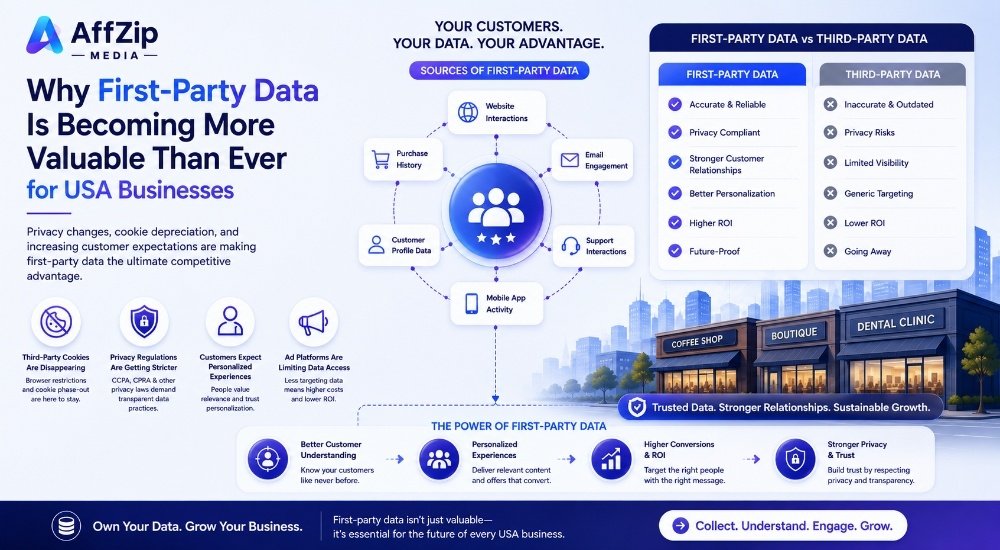
First-party data refers to information that a business collects directly from its customers and website visitors. This data comes from sources such as website forms, customer accounts, purchase history, email subscriptions, surveys, CRM systems, and customer interactions.
Unlike third-party data, which is purchased or collected from external sources, first-party data belongs directly to the business. Because it comes from actual customer interactions, it is often more accurate, relevant, and reliable.
Examples of first-party data include customer names, email addresses, phone numbers, purchase behavior, website activity, customer preferences, and engagement history.
Why Third-Party Cookies Are Disappearing
For many years, advertisers relied on third-party cookies to track users across multiple websites and deliver highly targeted advertising campaigns. However, growing concerns about online privacy have led browsers and technology platforms to reduce support for third-party tracking.
Consumers are becoming more aware of how their personal information is collected and used. At the same time, privacy-focused regulations and technology updates are limiting access to third-party data sources.
As these changes continue, businesses can no longer depend entirely on external data providers. Building strong first-party data assets is becoming essential for maintaining effective marketing performance.
The Growing Importance of Data Privacy
Data privacy has become a major priority for both consumers and businesses. Customers want greater transparency and control over how their information is used.
Organizations that collect data responsibly and communicate clearly about privacy practices often build stronger trust with their audiences. Trust plays a critical role in customer acquisition and long-term customer retention.
First-party data strategies support privacy-focused marketing because businesses collect information directly from users who voluntarily engage with their brand.
How First-Party Data Improves Customer Acquisition
Successful customer acquisition depends on understanding customer needs, interests, and behaviors. First-party data provides businesses with valuable insights that help improve targeting and marketing effectiveness.
By analyzing customer interactions, businesses can identify high-intent prospects, improve audience segmentation, and create more relevant marketing campaigns.
Companies investing in Lead Generation Services often use first-party data to identify qualified leads and improve conversion rates throughout the customer journey.
The more accurately businesses understand their audience, the more effectively they can attract and convert potential customers.
The Role of First-Party Data in Marketing Automation
Marketing automation becomes significantly more powerful when fueled by accurate customer data. First-party data allows businesses to create automated workflows based on real customer actions and behaviors.
For example, businesses can automatically send personalized emails, follow-up messages, product recommendations, and promotional offers based on customer engagement patterns.
Implementing Marketing Automation & CRM Services helps organizations use first-party data to improve customer engagement while reducing manual marketing tasks.
This combination creates a more efficient and scalable customer acquisition process.
How CRM Systems Help Businesses Collect First-Party Data
Customer Relationship Management (CRM) platforms serve as central repositories for first-party data. These systems store customer information, communication history, purchase records, and engagement activity in a single location.
By integrating marketing and sales activities within a CRM platform, businesses gain a complete view of the customer journey. This visibility helps teams make more informed decisions and deliver more personalized experiences.
Businesses that invest in strong CRM strategies are often better positioned to maximize the value of their customer data assets.
Using First-Party Data for Better Personalization
Modern consumers expect personalized experiences. Generic marketing messages are often less effective than communications tailored to individual interests and behaviors.
First-party data enables businesses to segment audiences and deliver highly relevant content. Personalized recommendations, targeted promotions, and customized email campaigns help increase engagement and strengthen customer relationships.
Many businesses use Email Marketing Automation to deliver personalized communications based on customer preferences and interaction history.
This approach improves customer satisfaction while increasing conversion opportunities.
How First-Party Data Improves Advertising Performance
Advertising platforms are becoming increasingly dependent on first-party data for audience targeting and campaign optimization. Businesses that maintain strong customer databases can create more effective advertising campaigns while reducing wasted ad spend.
Organizations running Google Ads Management campaigns can use first-party audience data to improve targeting accuracy and maximize return on investment.
Similarly, businesses utilizing Meta Ads Management can create custom audiences and lookalike audiences based on their own customer information.
These strategies often produce better results than relying solely on broad targeting methods.
Why USA Businesses Must Build Their Own Data Assets
Businesses that own and control their customer data are less dependent on external platforms and changing privacy policies. First-party data becomes a long-term business asset that can support marketing, sales, customer service, and growth initiatives.
As privacy regulations continue to evolve, organizations with strong first-party data strategies will have greater flexibility and resilience. They will also be better equipped to adapt to future technology changes.
Companies that begin building first-party data systems today are creating a foundation for sustainable growth in the years ahead.
Businesses can further enhance customer engagement through Retargeting & Remarketing Services that leverage valuable first-party audience insights.
Why Businesses Choose AffZip Media
AffZip Media helps USA businesses develop customer acquisition strategies that combine first-party data, marketing automation, CRM integration, and performance marketing.
Our expertise includes Lead Generation, Google Ads Management, Meta Ads Management, Email Marketing Automation, Marketing Automation & CRM Services, and Retargeting & Remarketing Services.
We help businesses transform customer data into actionable insights that improve marketing performance and support long-term business growth.
Frequently Asked Questions
What is first-party data?
First-party data is information collected directly from customers through websites, forms, purchases, CRM systems, and customer interactions.
Why is first-party data important?
First-party data is more accurate, privacy-friendly, and valuable for customer acquisition, personalization, and marketing automation.
How can businesses collect first-party data?
Businesses can collect first-party data through website forms, email subscriptions, CRM systems, surveys, customer accounts, and purchase transactions.
Does first-party data help improve advertising performance?
Yes. First-party data helps businesses create better audience segments, improve targeting, and optimize advertising campaigns.
Can marketing automation benefit from first-party data?
Absolutely. First-party data powers personalized marketing workflows, automated follow-ups, customer segmentation, and engagement campaigns.
Conclusion
First-party data is quickly becoming one of the most valuable assets a business can own. As third-party tracking declines and privacy expectations increase, organizations must focus on building direct relationships with customers and collecting data responsibly.
Businesses that invest in first-party data strategies can improve customer acquisition, strengthen personalization efforts, optimize advertising performance, and create more effective marketing automation systems. In an increasingly privacy-focused digital landscape, first-party data provides a competitive advantage that supports sustainable long-term growth.
Need help with marketing automation and customer data strategies? Contact AffZip Media for a free strategy consultation.